The Bonsoy Gold Coast Pro kicks off May 1 on one of Australia’s most iconic stretches of coast.
For the surfers competing at Snapper Rocks, the next ten days will demand more from their bodies than almost any other environment in professional surfing — explosive pop-ups in overhead-plus surf, repeated sprint paddles to the lineup, and hours of high-intensity output across multiple heats.
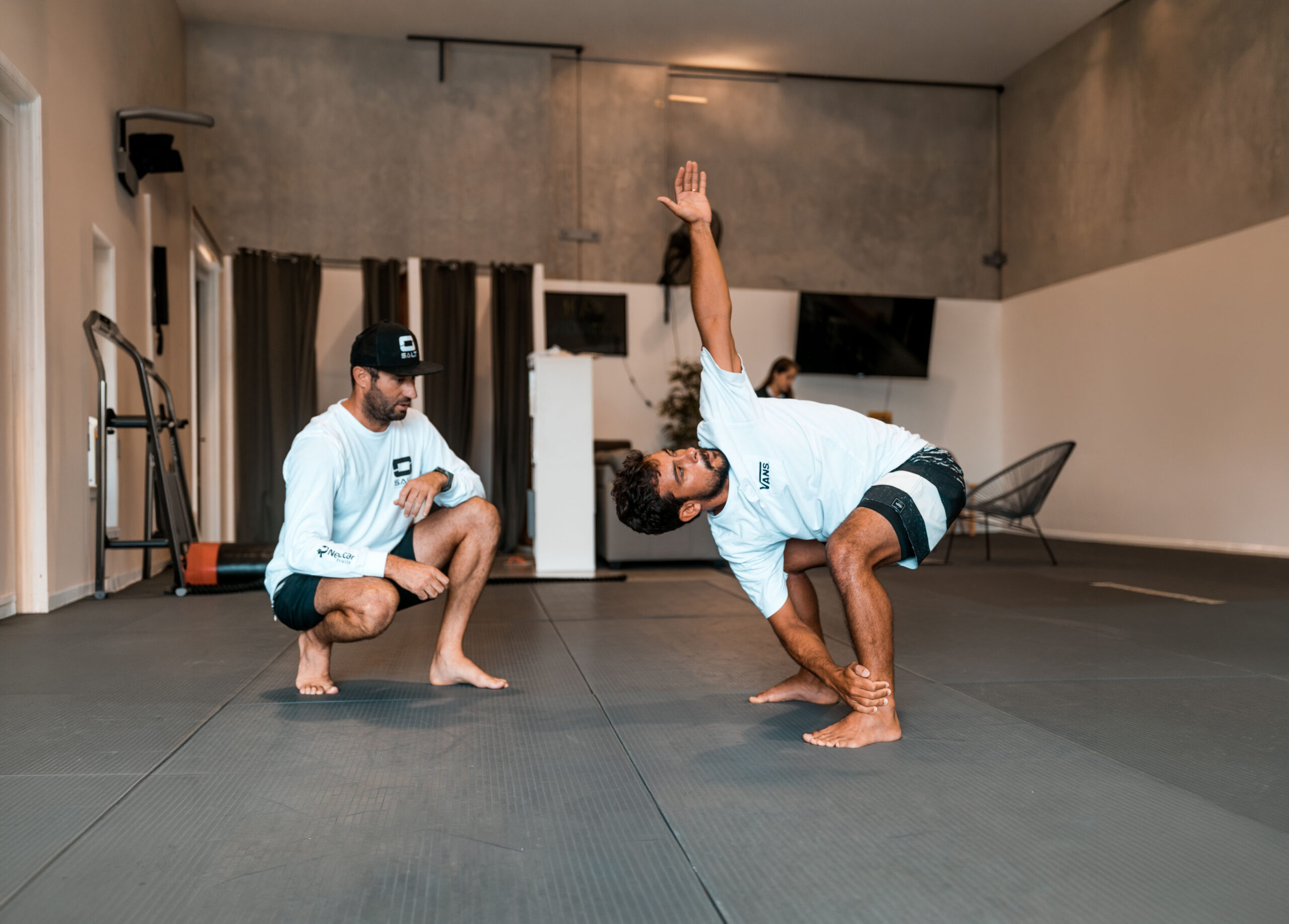
For SALT coach Marcos Freitas, this event is personal. Two athletes he works with — Mateus Herdy and Alejo Muniz — are among the competitors on the start list.
What does their preparation actually look like? And what can any surfer take from it?
What Competing at an Event Like This Actually Demands
Most people assume professional surfers are naturally gifted athletes who barely need to train. The reality is the opposite.
The physical demands of competing at the Gold Coast Pro are specific, accumulative, and unforgiving:
- Paddle volume across multiple days. Repeated heats mean serious paddle loads. Shoulders, lats, and rotator cuffs need to sustain power — not just for one session, but for the full duration of the event.
- Explosive repeatability. The pop-up happens in under a second. Do it clean on wave one. Do it clean on wave forty. Training for that repeatability requires neuromuscular conditioning that most gym programs never touch.
- Heat-length endurance. A competition heat runs 20 to 35 minutes of near-continuous high output. That’s a different energy system than a casual surf — and it needs to be trained specifically.
- Fast recovery. Competing on back-to-back days in variable conditions means the body needs to bounce back quickly. Mobility work and soft tissue health aren’t optional at this level — they’re a direct competitive edge.
This is the context Marcos trains his athletes within. Every session has a purpose. Every load is deliberate. Every phase is planned.
The SALT Methodology — Built From the Elite, Designed for Everyone
Here’s the thing about elite surf training: the principles don’t change based on your level.
A professional surfer competing at the Gold Coast Pro and a weekend warrior trying to make it through a two-hour session need the same physical qualities — paddle endurance, explosive pop-up mechanics, core rotation, lower body stability, and injury resilience. The volume and intensity differ. The methodology doesn’t.
This is the foundation the SALT 6-Week Surf Fitness Program is built on.
Marcos didn’t create a watered-down version of what his athletes do. He took the same movement philosophy — the same understanding of what surfing actually demands from the body — and structured it into a program that any surfer can run, anywhere, in 30 minutes a session.
The surfer preparing for Snapper Rocks and the surfer trying to stop fading in the second hour of a local session have the same fundamental problem: a body that isn’t fully prepared for what surfing asks of it.
What Elite Surf Preparation Actually Looks Like
The specifics of athlete programming stay between a coach and their athletes. But the principles behind preparing for an event like the Gold Coast Pro are the same ones that improve any surfer’s performance:
Peaking at the right time.
Training builds over weeks and months. The goal isn’t maximum output during preparation — it’s arriving at the event fresh, sharp, and ready. That means intentional load management and knowing when to push and when to pull back.
Movement quality over raw strength.
A surfer who produces explosive power through full ranges of motion is more effective than one who simply lifts heavy. Surf-specific strength targets the movement patterns the ocean actually asks for — not the ones that look good in a gym.
Nervous system readiness.
Pop-up speed, reaction time, and spatial awareness in the water are all affected by how recovered and primed the nervous system is. Elite preparation accounts for this. Most amateur training ignores it entirely.
Mobility as performance.
Open hips, a mobile thoracic spine, and healthy shoulders don’t just reduce injury risk — they expand what’s physically possible on a wave. Restricted movement limits what surfers can access in the critical moments that decide whether they make or miss a turn.
These aren’t secrets exclusive to professional athletes. They’re principles every surfer can train — and they’re systematically built into the SALT program over six weeks.
Train Like It Matters — Starting Before the Event Ends
You don’t need to be on the start list at Snapper Rocks to train like it matters.
The SALT 6-Week Surf Fitness Program brings the same coaching philosophy Marcos applies with his athletes directly to your phone. 30-minute sessions, no gym required, structured around what surfing actually demands from your body.
If you’re watching the Gold Coast Pro and wondering what it would feel like to have that kind of fitness in the water — or you just want to stop fading after an hour at your local break — this program was built for exactly that gap.
SALT Performance Training is a surf-specific fitness program created by coach Marcos Freitas. The SALT methodology is designed to help surfers of all levels improve their performance, endurance, and longevity in the water.