The Bonsoy Gold Coast Pro is done. Snapper Rocks delivered. And two Australians — Ethan Ewing and Stephanie Gilmore — walked away as champions.
If you watched any of it, you saw what elite surfing looks like when a body is fully prepared for the demands of competition. If you didn’t, here’s what you missed — and more importantly, what it means for how you should be training.
The Results
Men’s Champion: Ethan Ewing (AUS) claimed his third CT title, beating Connor O’Leary in the final at Snapper Rocks. Ewing’s surfing throughout the event was a masterclass in power, precision, and repeatability — every turn explosive, every heat managed with physical composure.
Women’s Champion: Stephanie Gilmore (AUS) extended her own record with her seventh Gold Coast Pro title and 34th CT win. In the semifinals, Gilmore put up a 15.00 heat total — a scoreline that only happens when everything is working. Body. Mind. Preparation.
Luana Silva (BRA) finished runner-up in the women’s and now holds the World No. 1 ranking going into the next stop. Connor O’Leary (JPN) was a standout throughout the men’s draw, pushing Ewing all the way to the final.
And Samuel Pupo (BRA) was the performance highlight of the men’s competition — posting a CT career-best 9.73 that had the crowd and commentators talking. That kind of score doesn’t come from talent alone.
What Snapper Rocks Demands From a Surfer’s Body
Snapper is one of the most physically exposing venues on the CT calendar. The wave is fast, mechanical, and unforgiving — it rewards explosive entry into turns, demands sustained rail-to-rail power through long walls, and punishes anyone whose body starts to fade mid-heat.
When you watch a surfer at Snapper, you’re watching the result of months of deliberate preparation. Not the talent. The work.
The physical demands of competing at this level include:
- Explosive repeatability. Heat after heat, wave after wave — the pop-up happens in under a second. At Snapper, where waves come in sets and hesitation costs scoring opportunities, that movement needs to be automatic and powerful every single time. That’s trained.
- Sustained paddle capacity. A CT heat runs 20 to 35 minutes of near-continuous effort. Multiply that across multiple rounds over multiple days and the cumulative paddle load is enormous. Surfers who fade in the back half of a heat aren’t less talented — they’re less conditioned.
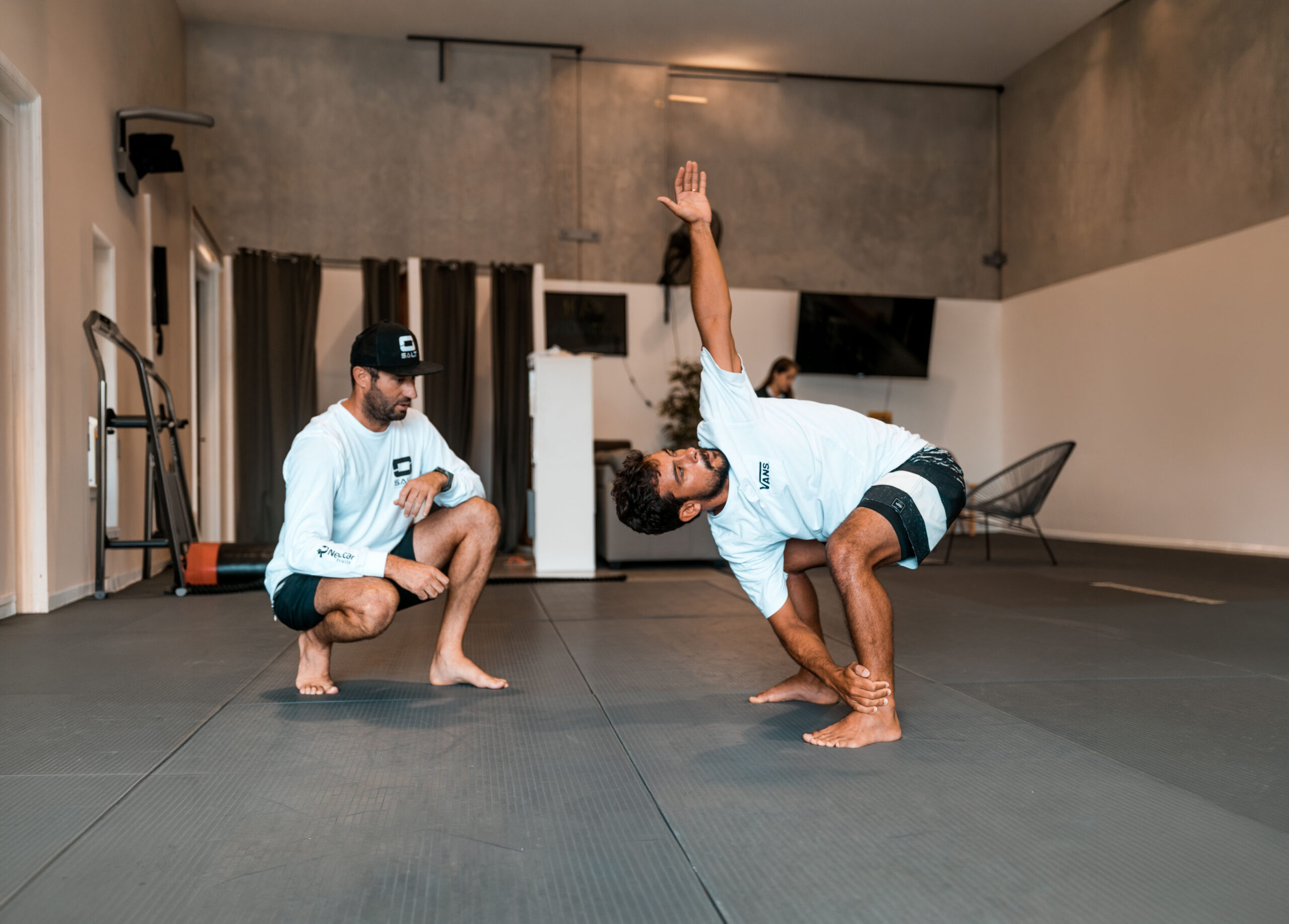
- Hip mobility and rotation under pressure. The turns Ewing put up in the final — full-rail carves that redirected tonnes of water — start from the ground up. Open hips, mobile thoracic spine, and coordinated rotation through the whole chain. Restrict any part of that and the turn doesn’t happen.
- Mental sharpness through physical fatigue. Wave selection, heat strategy, and decision-making don’t get easier when the body is under load. Physical conditioning isn’t just about performance on the wave — it’s about staying sharp enough to find the right waves and make smart decisions across a 30-minute heat.
The SALT Connection to the Gold Coast
SALT coach Marcos Freitas isn’t watching this event from a distance. He works directly with athletes competing at this level — including Alejo Muniz, who was on the start list this week at Snapper Rocks.
The training methodology that Marcos applies with CT-level athletes isn’t a different system to what he built into SALT. It’s the same philosophy: understand what surfing specifically asks of the body, and train for exactly that — at whatever level of output is appropriate for the individual athlete.
An athlete preparing for a CT heat and a surfer preparing for a two-hour session at their local break need the same physical qualities. The load is different. The movement patterns, the energy systems, the injury prevention principles — those are identical.
This is what separates surf-specific training from generic fitness. And it’s what the SALT 6-Week Surf Fitness Program is built around.
What You Should Take From This Event
Watching the Gold Coast Pro isn’t just entertainment. It’s a reference point.
The surfers you watched this week didn’t stumble into those performances. They built them — through consistent, purposeful training that targeted exactly what Snapper Rocks would demand from their bodies.
Most recreational surfers train nothing at all, then wonder why they’re fading after an hour or missing the pop-up on the waves that matter. Or they train generically — gym programs that build muscle without building surf fitness.
The gap between watching elite surfing and experiencing it in your own body isn’t as large as it looks. It’s a training problem. And training problems have solutions.
Three things every surfer should be working on — based on exactly what this week’s performances revealed:
- Paddle endurance built for surfing, not swimming. Surf-specific paddling engages different muscles in different patterns than lap swimming. If your shoulders are burning by the second set, you’re not deconditioned — you’re untrained for surfing specifically.
- Pop-up power and repeatability. Drill the movement pattern. Build the explosive strength through the right ranges of motion. Don’t just do it on a surfboard — train it deliberately so the body knows what to do without thinking.
- Mobility as a performance tool. Gilmore’s ability to generate that 15.00 heat total didn’t come from strength alone. It came from a body that moves freely through full ranges — and that doesn’t happen by accident.
The Same Methodology. Any Level.
The SALT 6-Week Surf Fitness Program brings the principles behind elite surf preparation to any surfer — anywhere in the world, without a gym or equipment.
30-minute sessions. No gear required. Structured specifically around what surfing demands from the body — designed by the coach who applies these principles with athletes competing on the CT.
If this week’s event sparked something — if you watched Ewing in the final or Gilmore on a wall and thought “I want that kind of fitness in the water” — this is where to start.
Snapper Delivered. Now It’s Your Turn.
The Gold Coast Pro is wrapped. The CT moves on to the next stop. The best surfers in the world are already thinking about what comes next — and training accordingly.
The question is whether you are too.
Surfing better isn’t about waiting for better conditions or better waves. It’s about showing up with a body that’s ready for whatever the ocean gives you. That’s what SALT is built for.
SALT Performance Training is a surf-specific fitness program created by Gold Coast coach Marcos Freitas. Built on the same methodology used with WSL Championship Tour athletes — designed for every surfer who wants to paddle harder, pop up faster, and last longer in the water.