
What This Wave
Demands From
Your Body
The WSL Championship Tour is in El Salvador this week. The wave is Punta Roca — a long, powerful right-hand point break on the Pacific coast, famous for its long walls, its grinding sweep current, and its ability to expose every weakness in a surfer’s physical preparation.
Watch any broadcast from this event and you’ll see what world-class surfing looks like. What you won’t see is what made those performances possible — the months of deliberate physical preparation that happened before a single athlete paddled out at Punta Roca.
This post breaks down what this wave specifically demands, why those demands matter to every surfer regardless of their level, and what to do about it.
Why Punta Roca Is One of the Most Physical Waves on Tour
Punta Roca isn’t a novelty event. It’s one of Central America’s most respected right-hand point breaks, and it rewards athletes who’ve done the work in a way that more forgiving waves simply don’t.
Three things make it particularly demanding compared to other CT stops:
- The sweep current is relentless. Punta Roca has a strong lateral sweep that pulls surfers off the peak between waves. Every ride requires paddling back against that current to hold position. This isn’t a one-wave effort — it compounds across an entire heat.
- It’s a right-hander. That means backhand surfing for the majority of regular-footers in the field. Backhand surfing loads the hip flexors, core rotators, and front shoulder chain significantly more than frontside surfing. Without specific preparation, technique degrades rapidly under fatigue.
- The walls are long. Multiple turns per wave is the norm at Punta Roca. That means the body needs to produce and maintain power across four, five, sometimes six turns on the same ride — not just the first one.
“At an event like El Salvador, the athletes who are still surfing at 100% in the final minutes of their heats aren’t the most talented. They’re the most prepared.”
Add tropical conditions — heat, humidity, and the physical load of extended time in warm saltwater — and you have one of the most demanding environments on the entire CT calendar.
Three Physical Demands the El Salvador Pro Exposes
1. Paddle Endurance — Not Just Power
There’s a common misunderstanding about paddle fitness. Most surfers think about explosive paddle power — the burst you need to catch a wave. What Punta Roca actually tests is something different: sustained paddle endurance.
When you’re fighting a sweep current to hold your position in the line-up, you’re not paddling in short bursts. You’re paddling continuously, repeatedly, for the duration of a 30-minute heat or a full session. The athletes who lose ground in the line-up at events like this aren’t weak — they’ve just undertrained that specific capacity.
Training the paddle endurance engine looks different from training paddle power. It requires sustained effort at moderate intensity — the kind of work that builds the cardiovascular and muscular base your paddle sprint draws from.
2. Backhand Rotation Under Fatigue
Surfing backhand at quality is a skill. Surfing backhand at quality when you’re physically fatigued is a test of whether you’ve done the preparation.
The front shoulder drive, the hip rotation, the weight shift from heel to toe edge — all of these movement patterns demand active mobility and neuromuscular coordination. When fatigue hits, the body defaults to its compensations. For most surfers, those compensations show up as flat turns, late weight shifts, and missed sections.
The preparation for this is specific: hip mobility work targeting the rotation range you need, and movement quality training that conditions those patterns to hold up when the body wants to cut corners.
3. Multi-Turn Fitness — Holding Power From Start to Finish
A wave at Punta Roca doesn’t give you one turn and ask you to survive the rest. It gives you a long, walling right-hander and asks you to drive power through every section.
The physical demand here is conditioning that doesn’t fade. Your first turn and your fifth turn need the same force, the same commitment, the same coordination. That’s a different quality than general aerobic fitness — it’s specific surf endurance, and it’s trained by working with minimal rest intervals that replicate what the water actually demands.
Fitness always shows up in the second half.
Whether it’s the back half of a long wave at Punta Roca, the final 20 minutes of a surf session, or the closing sets of a heat — the moment physical preparation runs out is the same moment surfing quality drops. The gap between watching El Salvador and surfing like it is almost always a fitness gap, not a technique gap.
What This Means for Your Surfing
You’re not competing at Punta Roca. But the physical demands of that wave aren’t exclusive to CT-level surfing.
Every surfer who has faded in the second half of a long session has experienced a version of the same problem. Every surfer who has lost ground in the line-up on a current-y day has been tested by the same demand. Every surfer who has felt their turns flatten out late in the session has run into the same physical limitation.
The difference between watching the El Salvador Pro and benefiting from it is understanding that the physical qualities on display this week are trainable. Paddle endurance is trainable. Backhand rotation is trainable. Multi-turn fitness is trainable.
The question is whether you’re doing the work in the right way.
How to Train for These Demands
The athletes competing at Punta Roca this week didn’t build those physical qualities by surfing more. They built them through structured, deliberate training that targeted the specific demands of competitive surfing.
The same methodology applies to every level of surfer. Here’s the framework:
- Paddle endurance sessions: Prone paddle intervals — sustained effort at 60–70% intensity, not sprint efforts. Three to five rounds of 60 seconds on, 15 seconds off. This builds the engine that feeds your sprint.
- Hip mobility before every session: Slow hip circles, 90/90 transitions, lizard pose holds. Two minutes is enough. It primes the rotation range your backhand surfing pulls from.
- Minimal rest intervals in your training: The reason the SALT program works isn’t that the movements are complicated — it’s that the rest intervals are intentionally short. That trains the body to stay sharp when it wants to stop. That’s exactly what Punta Roca demands.
- Progressive overload over six weeks: Don’t peak in week one. Build volume and intensity progressively so that by the time you’re three sessions deep in a surf trip, your body is running better, not worse.
The SALT Approach — Built From WSL, Designed for Every Surfer
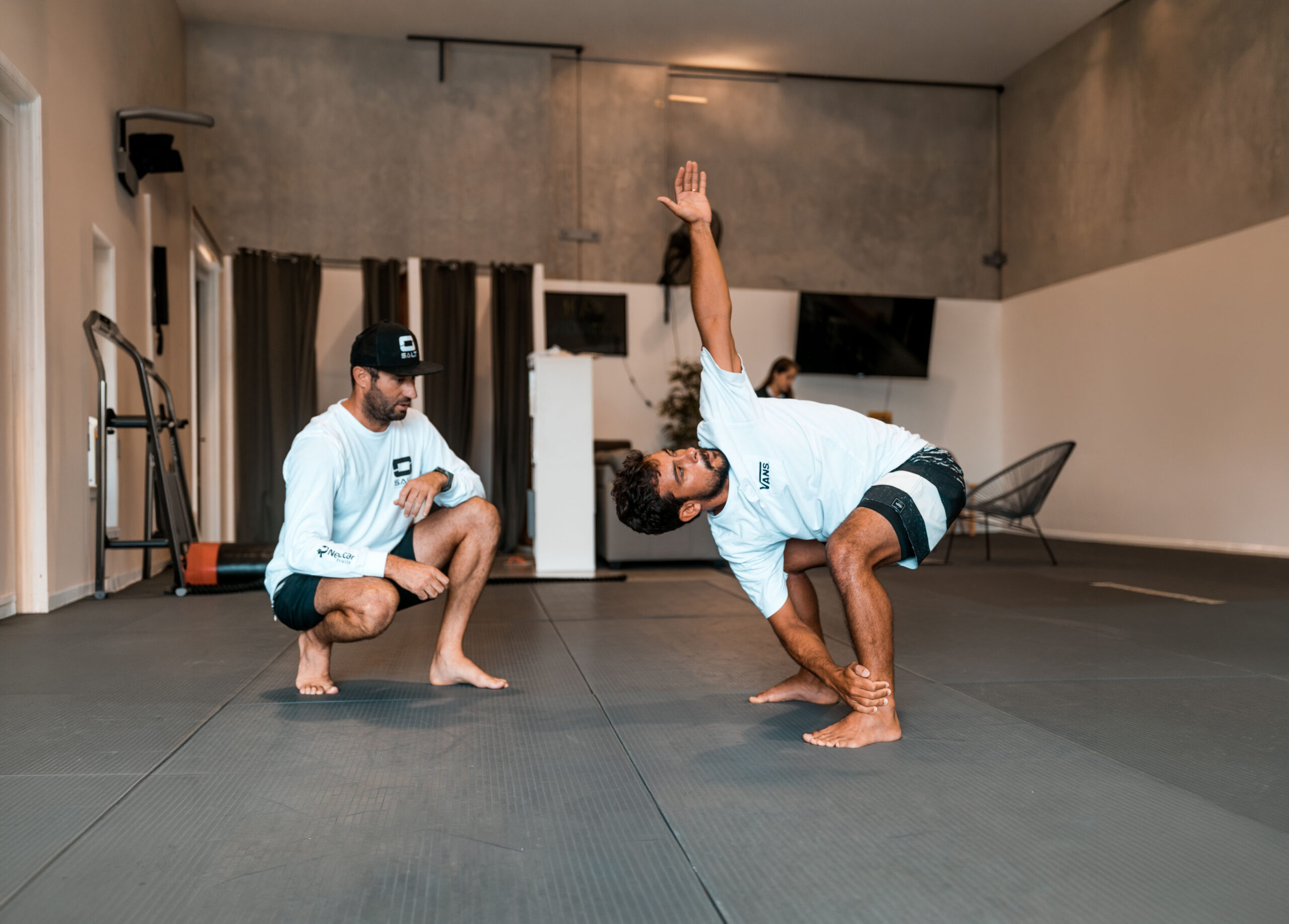
The SALT 6-Week Surf Fitness Program was built on the same methodology Marcos Freitas uses with WSL athletes. Not a simplified version. Not a watered-down approximation. The same physical principles — applied to a structure that works for surfers with real lives and limited time.
30 minutes. Three sessions a week. No gym. No equipment. The program targets paddle power, pop-up mechanics, core rotation, hip mobility, and surf endurance — the exact physical qualities that the El Salvador Pro is showcasing this week.
The surfer watching the CT broadcast and the athletes competing at Punta Roca share the same fundamental challenge: building a body that performs in the water, session after session, for as long as possible. The program is how you start that work.
Build the Fitness
Punta Roca Demands
6 weeks. 30 minutes. No gym. The same methodology Marcos uses with WSL athletes — structured for every surfer.
Start the 6-Week Program →
saltpt.com.au · Gold Coast, Australia · June 2026